
Is it Halal? Scan the barcode and know.
Free. No account, no third-party tracking.
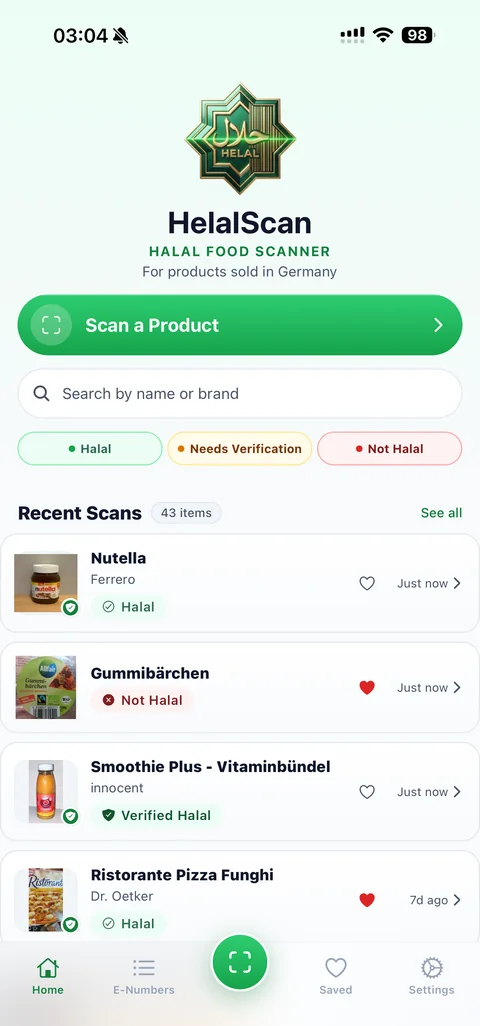
How it works
Three seconds, three steps
A Halal food checker that needs no hard ingredient names and no guessing. Point the camera at the barcode and read the reason.
Scan the barcode
Point your camera at the barcode on the pack. No typing, no account, no sign-up.
Read the answer
Halal, doubtful, or not Halal — with the flagged ingredients named, never a bare label.
See why
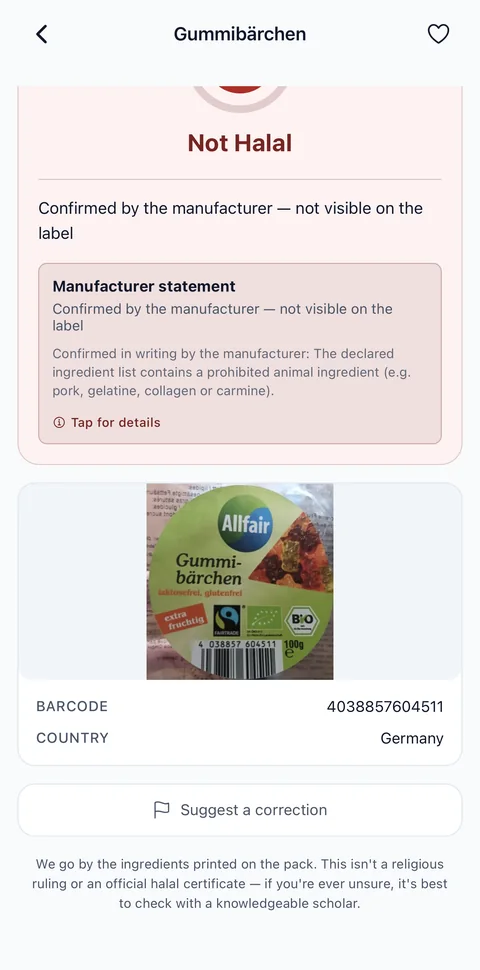
Every flag explains itself in plain language, and quotes the manufacturer where we have their written statement.
A real scan
It names the ingredient, not just the answer
A supermarket pizza, scanned in the shop. Here is what the app actually shows.
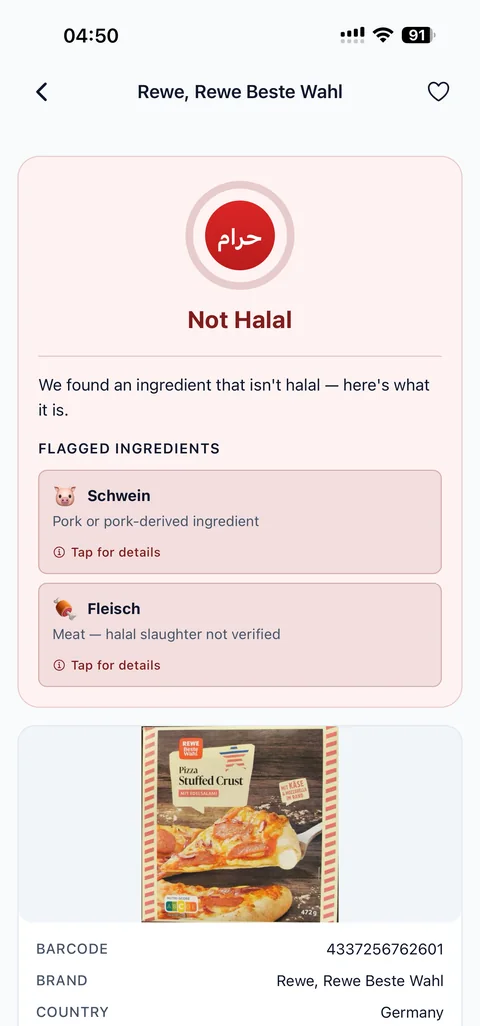
Stuffed Crust Pizza — Not Halal
- SchweinPork or pork-derived ingredient
- FleischMeat, Halal slaughter not verified
It reads the German declaration and answers in your language. Tap any flag and the app explains what the ingredient is and why it matters.
Inside the app
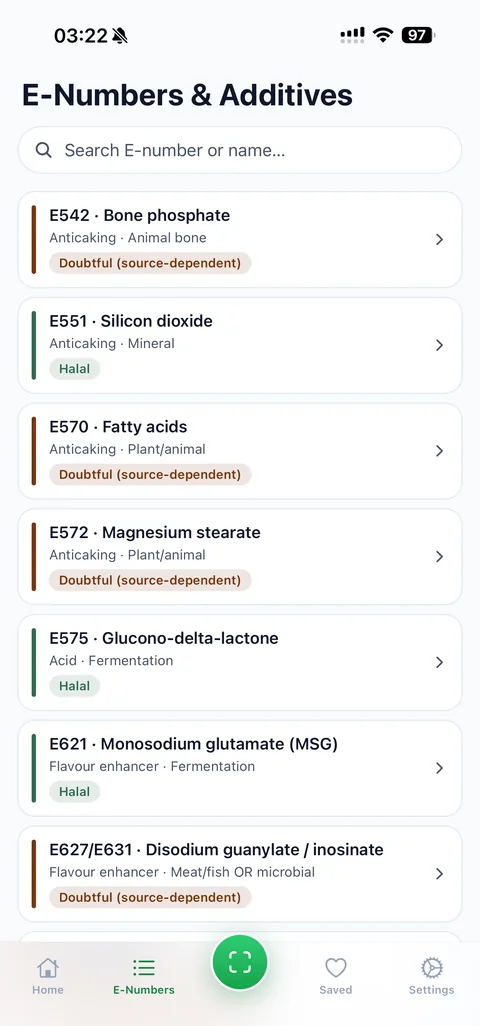
Built for the supermarket aisle
What the answers mean
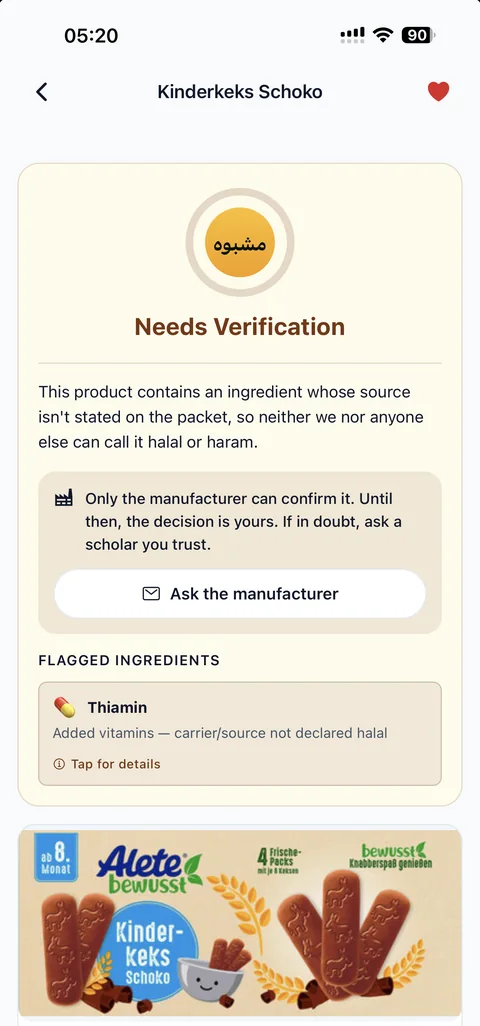
Four answers, and "doubtful" is one of them
Many additives can be plant or animal in origin and the label never says which. Calling those Halal without checking is guessing, so we say so instead.
Why trust it
Honest about what a label can and cannot tell you
What Helal Scan is, what each answer means and where its information comes from, on one page: What is Helal Scan? →
Manufacturer statements
Where we have written confirmation from the maker about an ingredient's source, the answer quotes it directly — evidence a label cannot show.
What scholars say
For the common doubtful ingredients the app shows what the Hanafi, Maliki, Shafi’i and Hanbali schools say, with sources, so you can weigh them yourself.
No accounts, no tracking
No sign-up, and no ad or analytics SDKs. Photos never leave your phone. How your data is handled →
Guides
The questions a label never answers
Written the way we would explain it to a friend in the shop, with the same reasoning the app uses.
Is gelatin Halal?
Pork, beef or fish: the pack rarely says which animal, and what Halal gelatin means.
Is E471 Halal?
Plant oil or animal fat, and the label does not have to say.
Is wine vinegar or vanilla extract Halal?
Alcohol in food: vinegar, vanilla extract, sugar alcohols and flavour carriers, and what counts.
Is Haribo Halal?
HARIBO's own answer for 116 sweets, gummy bears included: which are confirmed, which contain gelatin (mainly pork, says HARIBO).
Is rennet Halal?
Animal, microbial or vegetarian rennet: what the label says and what the app shows for cheese.
Look up an E-number right now
Free, no app needed: 170 additives with what each one means for Halal, and why the source matters.
The app is available on iPhone today.
Questions
Common questions
How do I check if a product is Halal?
Read the declared ingredient list and check every additive — or let a scanner do it. Helal Scan reads the full declaration from a barcode, flags what is doubtful or prohibited, and explains every flag in English, German, Arabic or Turkish.
Which E-numbers are not Halal?
Gelatine (E428/E441) is not Halal unless its source is verified, and E120 carmine, made from insects, is treated as not Halal. Many more depend on their source: E471 mono- and diglycerides, E904 shellac, E631 flavour enhancers, E920 L-cysteine. The full list with reasons is in the E-number checker.
Is the answer a fatwa?
No, and we say so everywhere. Answers combine published scholarly positions with ingredient analysis and can be incomplete or out of date. For anything that matters, verify with the manufacturer and a qualified authority.
Does it work offline?
Products you have already scanned stay readable without a connection, and the app shows when it last checked. A fresh scan needs a connection, because the ingredients are looked up on our server.
What if a product is missing?
Photograph the ingredient list. The app reads the text on your phone, you confirm it, and only the text is sent — never the photo. That adds the product for everyone else.